Using Traefik as Reverse Proxy
Best Choice
- No custom middleware required for WebSockets or HTTP/2
- Traefik issues and renews Let’s Encrypt certificates automatically
- Integrates cleanly with Docker labels, Kubernetes ingress, and static config files
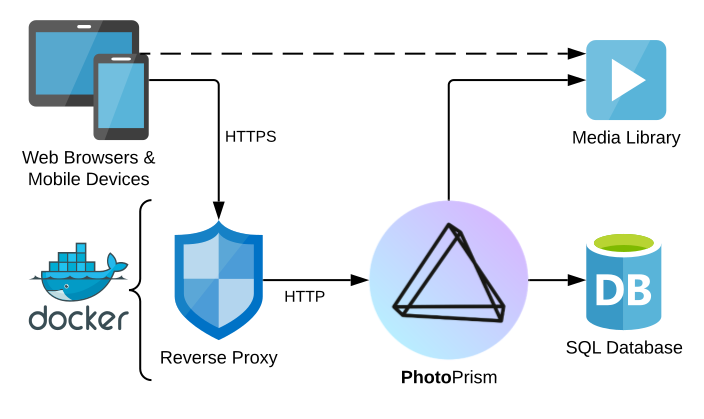
To run PhotoPrism behind Traefik, create a traefik.yaml configuration and then add a traefik service to your compose.yaml or docker-compose.yml file, as shown in the following example. Set the public Site URL to the external https:// address. If Traefik reaches PhotoPrism from an address outside Docker’s default internal range, also add its IP or CIDR to PHOTOPRISM_TRUSTED_PROXY.
compose.yaml
services:
  traefik:
    image: traefik:v3.7
    restart: unless-stopped
    ports:
      - "80:80"
      - "443:443"
    volumes:
      - "./traefik.yaml:/etc/traefik/traefik.yaml"
      - "./traefik/data:/data"
      - "/var/run/docker.sock:/var/run/docker.sock:ro"

  photoprism:
    image: photoprism/photoprism:latest
    restart: unless-stopped
    labels:
      - "traefik.enable=true"
      - "traefik.http.routers.photoprism.rule=Host(`photos.example.com`)"
      - "traefik.http.routers.photoprism.entrypoints=websecure"
      - "traefik.http.routers.photoprism.tls=true"
      - "traefik.http.routers.photoprism.tls.certresolver=myresolver"
      - "traefik.http.services.photoprism.loadbalancer.server.port=2342"
    volumes:
      - "./originals:/photoprism/originals"
      - "./storage:/photoprism/storage"
    environment:
      PHOTOPRISM_SITE_URL: "https://photos.example.com/"
      PHOTOPRISM_DISABLE_TLS: "true"
traefik.yaml
log:
  level: INFO

global:
  sendAnonymousUsage: false

entryPoints:
  web:
    address: ":80"
    http:
      encodedCharacters:
        allowEncodedSlash: true
        allowEncodedPercent: true
        allowEncodedHash: true
        allowEncodedQuestionMark: true
        allowEncodedSemicolon: true
        allowEncodedBackSlash: true
        allowEncodedNullCharacter: true
      redirections:
        entryPoint:
          to: websecure
          scheme: https
    transport:
      respondingTimeouts:
        readTimeout: "3h"
        writeTimeout: "0s"
        idleTimeout: "3m"
  websecure:
    address: ":443"
    http:
      encodedCharacters:
        allowEncodedSlash: true
        allowEncodedPercent: true
        allowEncodedHash: true
        allowEncodedQuestionMark: true
        allowEncodedSemicolon: true
        allowEncodedBackSlash: true
        allowEncodedNullCharacter: true
    transport:
      respondingTimeouts:
        readTimeout: "3h"
        writeTimeout: "0s"
        idleTimeout: "3m"

providers:
  docker:
    exposedByDefault: false
    watch: true

api:
  insecure: false
  dashboard: false
  debug: false

certificatesResolvers:
  myresolver:
    acme:
      email: ssl-admin@example.com
      storage: /data/certs.json
      httpChallenge:
        entryPoint: web
Note that you must disable HTTPS/TLS in PhotoPrism by setting PHOTOPRISM_DISABLE_TLS to "true", because Traefik is already handling TLS termination. The service label traefik.http.services.photoprism.loadbalancer.server.port=2342 tells Traefik which internal port to use.
Timeouts & Encoded Characters
Two settings in the example above are easy to leave out:
respondingTimeoutsis the important one. Traefik's defaultreadTimeoutis 60 seconds, and it limits reading the entire request including the body — so any upload that takes longer than a minute to transfer is cut off, which is easy to hit with large videos or a slow connection. A generousreadTimeoutremoves that limit, andwriteTimeout: "0s"disables the write limit so streaming a large original is not interrupted.-
encodedCharactersdecides whether percent-encoded characters are allowed in a request path. File and folder names legitimately contain/,%,#,?,;,\and so on, so a blocked character makes the affected files fail to load. Requires Traefik v3.6 or later — on older versions the option is unknown and Traefik refuses to start.⚠ Set every option explicitly rather than relying on the defaults. Traefik changed these defaults twice inside the v3.6 patch series: encoded characters were rejected from v3.6.4 and allowed again from v3.6.7. A floating tag such as
traefik:v3.6therefore changed behavior without any change on your side, and Traefik now states that configuring them is the user's responsibility. See Traefik's migration notes for the history.⚠ There is also a separate
encodedCharactersmiddleware with the same option names but the opposite default — it allows none unless you enable them. Don't mistake one for the other.
Set both on each entry point, since a request can arrive on either before the redirect to HTTPS.
Further traefik.yaml examples and a detailed description of the Traefik configuration can be found in the corresponding documentation.
Why Use a Proxy?
If you install PhotoPrism on a public server outside your home network, always run it behind a secure HTTPS reverse proxy. Your files and passwords will otherwise be transmitted in clear text and can be intercepted by anyone, including your provider, hackers, and governments. Backup tools and file sync apps may refuse to connect as well.
Help improve these docs! You can contribute by clicking to send a pull request with your changes.